Your curriculum. Connected.
The Keystone Knowledge Graph maps how learning objectives relate to topics and source materials. As educators build in Course Design, activities and assessments link back to those objectives.
Move from a program-wide view to a single objective to see what supports it, how it is assessed, and where a change may have an effect. That traceability helps institutions validate curriculum alignment, see whether a program covers what it promises, and keep supporting evidence current for program and accreditation review.
Start with what learners should know and be able to do.
Bring existing courses, syllabi, program outlines, or validated source materials into Keystone. The platform identifies the learning objectives and topics already present. Educators review and confirm each one, creating a connected starting point for the curriculum.
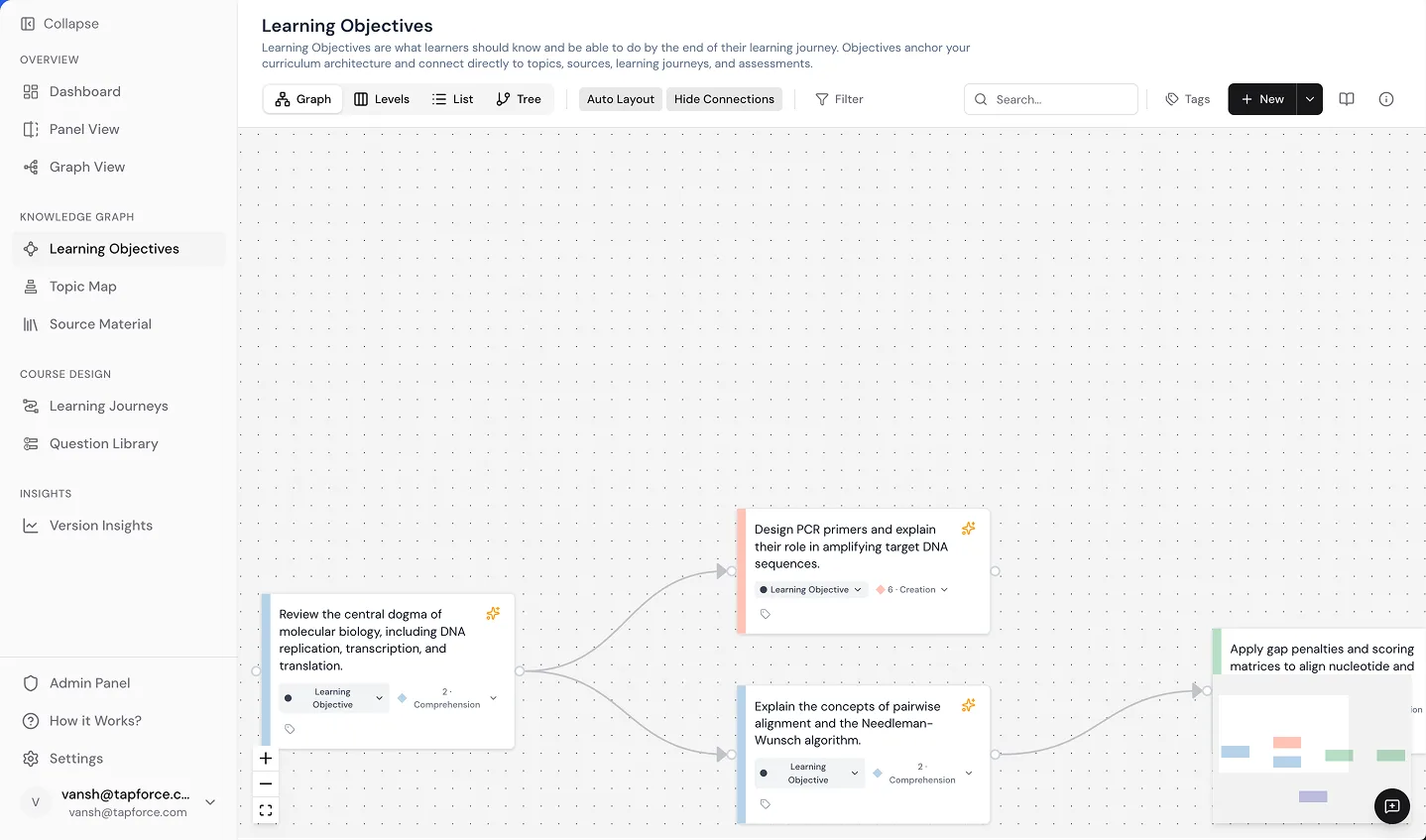
Each learning objective maps to the topics it covers and the source materials that support it. Activities and assessments link back to it, so educators can see whether the learning experience reflects what learners are meant to achieve.
Educators can build from connected curriculum in Keystone or bring in course materials developed elsewhere. Once organized in the platform, courses, activities, and assessments link back to the learning objectives, topics, and sources behind them. Any new learning material generated in Keystone requires a connected source. Those connections keep curriculum intent visible throughout the learning experience.
Explore the curriculum through Graph, List, Tree, or Bloom’s Taxonomy views. Move between the whole program and a single objective without losing context.
See where each topic fits.
Topic Maps organize the topics and concepts within a curriculum into a connected structure. See how subject matter is distributed across a program.
Select a topic to see its objectives and sources, then return to the program view. Easily find where a concept appears, what supports it, and where coverage could be stronger.
Keep the source behind the curriculum visible.
Bring institutional source materials into one searchable library. Keystone connects the exact excerpts to the topics and learning objectives they support. AI-assisted creation draws only from the connected source excerpts educators select. If no source is connected, Keystone does not generate new learning material for that area.
Trace an objective back to the exact excerpt behind it, or start with a source and see where it informs the curriculum.
Grounded from the start. Traceable as the curriculum evolves.
Keep curriculum intent connected to learning design.
The objectives, topics, and sources organized in the Knowledge Graph stay connected in Course Design, where educators link them to courses, activities, and assessments. What educators intend to teach stays connected to how learners experience it.
When an objective or source changes, the related learning stays connected, so educators know where to look.
One connected map of everything you teach.
With learning objectives, topics, sources, activities, and assessments linked in one traceable structure, institutions can build new programs from work already in place, understand what a change affects, and maintain a clear record that can support improvement and review. The result is a dynamic system that keeps what educators design tied to what learners experience.